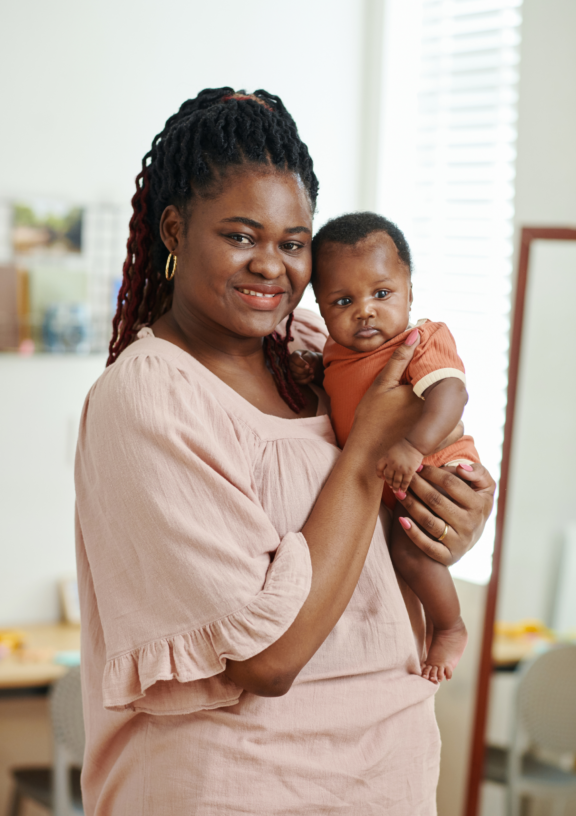
What Does It Mean to Be Postpartum? (And How Long It Really Lasts)

When most people hear the word “postpartum,” they think of one thing: postpartum depression.
I hear it constantly. A client will tell me she’s “worried about getting postpartum,” or a partner will ask whether his wife “has postpartum.” The word has become shorthand for a mental health condition — and in the process, we’ve lost what it actually means.
Postpartum is not a diagnosis. It’s a period of time. It’s the stretch after your baby is born when your body is healing, your hormones are recalibrating, your organs are physically relocating, and your entire identity is reorganizing itself around a person who didn’t exist a few weeks ago.
Postpartum depression is one thing that can happen during the postpartum period. It is not the postpartum period itself.
As a labor and delivery nurse with over a decade in Houston hospitals and the owner of Birthing Noire, I’ve watched that confusion cost women. When “postpartum” only means depression, everything else — the bleeding, the blood pressure, the exhaustion, the pelvic floor, the grief, the identity shift — becomes something you’re supposed to just get through quietly.
So let’s talk about what postpartum actually is, and how long it really lasts.
The Six-Week Myth
Ask most people how long postpartum lasts and you’ll hear “six weeks.” Ask most women, and they’ll tell you that’s when they got cleared at their checkup and were expected to resume normal life.
Here’s the thing: the medical field has already moved on from that number. Most of the public just hasn’t heard.
In 2018, the American College of Obstetricians and Gynecologists issued Committee Opinion 736, which restructured postpartum care entirely. ACOG now recommends that every woman have contact with a maternal care provider within the first three weeks after birth — not six — followed by ongoing care as needed, and a comprehensive visit no later than 12 weeks postpartum.
ACOG’s own framing is that postpartum care should be an ongoing process, not a single isolated appointment. They’ve been explicit that the old six-week model was built on convention rather than evidence.
The CDC goes further. According to the CDC, the risk of serious pregnancy-related complications continues for a full year after pregnancy ends. More than half of pregnancy-related deaths happen in the postpartum period — and they happen across that entire year, not in the first six weeks.
And policy has followed. In 2023, the Texas Legislature passed House Bill 12, extending Medicaid coverage for new mothers from 60 days to 12 months postpartum, effective March 2024. Texas didn’t do that because postpartum ends at six weeks.
So when does postpartum actually end?
Honestly? There isn’t a clean line. Twelve weeks is the clinical care window. Twelve months is the risk window. But ask any mother at fourteen months whether her body and her life have returned to what they were before, and you’ll get your real answer.
The more useful question isn’t “when does it end.” It’s “what do I need, and when do I need it.”
What’s Actually Happening in Your Body
The postpartum period isn’t passive recovery. Your body is doing active, demanding work.
Your uterus is shrinking. It goes from roughly the size of a watermelon back to the size of a pear. Those cramps you feel, especially while nursing, are afterpains — and they’re often sharper with each subsequent baby.
You’re bleeding. Lochia lasts for weeks, changing from bright red to pink to a creamy yellow-white as healing progresses. A sudden return to heavy bright-red bleeding after it had lightened is worth a call to your provider.
Your hormones are crashing. The drop in estrogen and progesterone after delivery is one of the steepest hormonal shifts the human body experiences. Night sweats, mood swings, and hair loss around three to four months are all downstream of it.
Your breasts are changing whether or not you’re breastfeeding. Engorgement, letdown, tenderness, leaking — all normal, all uncomfortable.
Your pelvic floor is recovering from months of carrying weight and, for many, the work of pushing. Leaking when you sneeze is common. It is not something you have to accept permanently.
If you had a cesarean, you had major abdominal surgery. Your incision is healing on the surface long before the internal layers are. That takes months, not weeks.
I’ve written in more depth on several of these:
- What Do Postpartum Moms Really Need? The Foundation Essentials
- Vaginal Birth Recovery: Complete Perineal Care Guide
- Cesarean Recovery Essentials: What C-Section Moms Actually Need
What’s Actually Happening Emotionally
Here’s where the conflation does the most damage — because emotional health is part of postpartum, just not the whole of it.
ACOG’s postpartum care framework covers seven distinct domains: mood and emotional well-being, infant care and feeding, sexuality and contraception, sleep and fatigue, physical recovery, chronic disease management, and health maintenance.
Mood is one of seven. That’s the proportion we’ve lost.
Within that one domain, there’s still enormous range:
Baby blues are the mild, short-lived version — weepiness, irritability, feeling flooded. They typically start within a few days and resolve on their own within about two weeks. Prevalence estimates vary dramatically across studies, from roughly 14% to as high as 76%, which tells you how differently it gets defined and measured.
Postpartum depression is different in depth and duration. About 1 in 8 mothers report symptoms — but only around 1 in 4 of those with symptoms ever receive a diagnosis.
Postpartum anxiety, OCD, and PTSD are real, distinct, and chronically under-discussed. Many women who don’t feel sad at all — who feel instead like they cannot stop scanning for danger — assume nothing is wrong because they don’t match the depression picture.
And one fact that surprises almost everyone: roughly half of postpartum major depressive episodes actually begin before delivery.
I’m going to cover all of this properly in a dedicated post, because it deserves more than a section.
The Signs That Mean Call Someone Now
This is the part I most want you to keep.
The CDC’s Hear Her campaign publishes a list of urgent maternal warning signs. Any of these warrant immediate medical attention, at any point in the year after birth:
- Severe headache that won’t go away or gets worse
- Changes in vision
- Dizziness or fainting
- Fever of 100.4°F or higher
- Trouble breathing
- Chest pain or a fast-beating heart
- Severe belly pain that doesn’t go away
- Severe nausea and vomiting
- Extreme swelling of hands or face
- Heavy vaginal bleeding, or foul-smelling discharge
- Swelling, redness, or pain in your leg
- Overwhelming tiredness
- Thoughts about harming yourself or your baby
The core message of that campaign is one I’d put on a wall: you know your own body better than anyone, and you can usually tell when something isn’t right.
If you raise one of these and get brushed off, say it again. Say it louder. Ask for it to be documented. Go to the emergency department if you need to. Being wrong costs you an afternoon. Being right and quiet can cost far more.
Why This Matters More in Texas
Texas has worse maternal mortality outcomes than most states — a finding named directly in a 2025 report from the Texas Advisory Committee to the U.S. Commission on Civil Rights, which identified inadequate postpartum care as a contributing factor.
And the burden isn’t evenly distributed. CDC data from 2023 put the maternal mortality rate for Black women at 50.3 deaths per 100,000 live births, compared with 14.5 for white women, 12.4 for Hispanic women, and 10.7 for Asian women.
If you’re birthing in Houston — at Texas Children’s Pavilion, Memorial Hermann, Houston Methodist, Texas Woman’s, anywhere — understanding your postpartum period isn’t optional background knowledge. It’s part of how you stay safe.
What’s Coming in This Series
This post is the foundation. Over the next few weeks I’m going deeper on the pieces that matter most:
- Postpartum preeclampsia — the warning signs, why it can start after you’re already home, and why so many women miss it
- Perinatal mood and anxiety disorders — the full picture beyond depression, and the diagnosis gap facing Black mothers
- The first 40 days — what cultures around the world have long understood about postpartum rest, and what America traded away
- Building your village — what to do when you don’t have one nearby
Three Books Worth Having on Your Nightstand
If you want to go deeper before the rest of this series publishes, these are the four I recommend most often to clients:
The First Forty Days by Heng Ou — the book that reframed postpartum rest for a lot of American mothers. Part guide, part cookbook, rooted in the traditions I’ll be writing about in a few weeks.

The Fourth Trimester by Kimberly Ann Johnson — the most thorough thing I’ve read on postpartum physical and emotional recovery as a single process rather than two separate ones.

Good Moms Have Scary Thoughts by Karen Kleiman — short, illustrated, and the book I hand to women who are terrified by intrusive thoughts and convinced they can’t tell anyone. If you read only one of these, read this one.

You Don’t Have to Do This Alone
Here’s what I’ve seen over hundreds of births: the mothers who recover best aren’t the ones with the most products or the tidiest nursery. They’re the ones who weren’t left alone with it.
That’s exactly why Birthing Noire offers postpartum doula support — overnight care so you can actually sleep, and daytime support focused on your recovery, feeding, and the practical load of a household with a newborn in it.
Postpartum isn’t six weeks. It isn’t a diagnosis. It’s a season, and you deserve to be held through it.
This post contains Amazon affiliate links. I earn a small commission from purchases made through these links at no additional cost to you. I only recommend books and products I’d tell a client to buy.